
We were finishing our visit to Central Asia in Uzbekistan, the country famous for its extraordinary Silk Road Heritage, its awesome Islamic architecture, the breathtaking desert and mountain landscape as well as the impact it had on the Golden Age of Islamic culture. Our visit wasn’t going to be very long unfortunately so we had to make some tough decisions and decided to visit just two of the main cities, the first one being Samarkand which is the home to the iconic Registan Square, an ancient city famed for its majestic, tile-covered madrasas. The second was Bukhara which is a UNESCO World Heritage site and known for the fifty meter Kalyan Minaret.


Uzbekistan was a major hub producing scholars and scientists way back in the Islamic Golden Age whose work shaped the modern world. Muhammad ibn Musa al-Khwarizmi who was the father of algebra was born in the Khwarezm region of Uzbekistan. The country is known for its bustling and vibrant markets; its national dish of Plov that can be found across all of the country, a steaming plate of rice, meat, vegetables and spices, which is absolutely delicious! It also offers a truly diverse geography and infrastructure with the deserts of Kyzylkum to the mountains of Tien Shan. We would highly recommend a visit, we only wish we could have stayed longer.
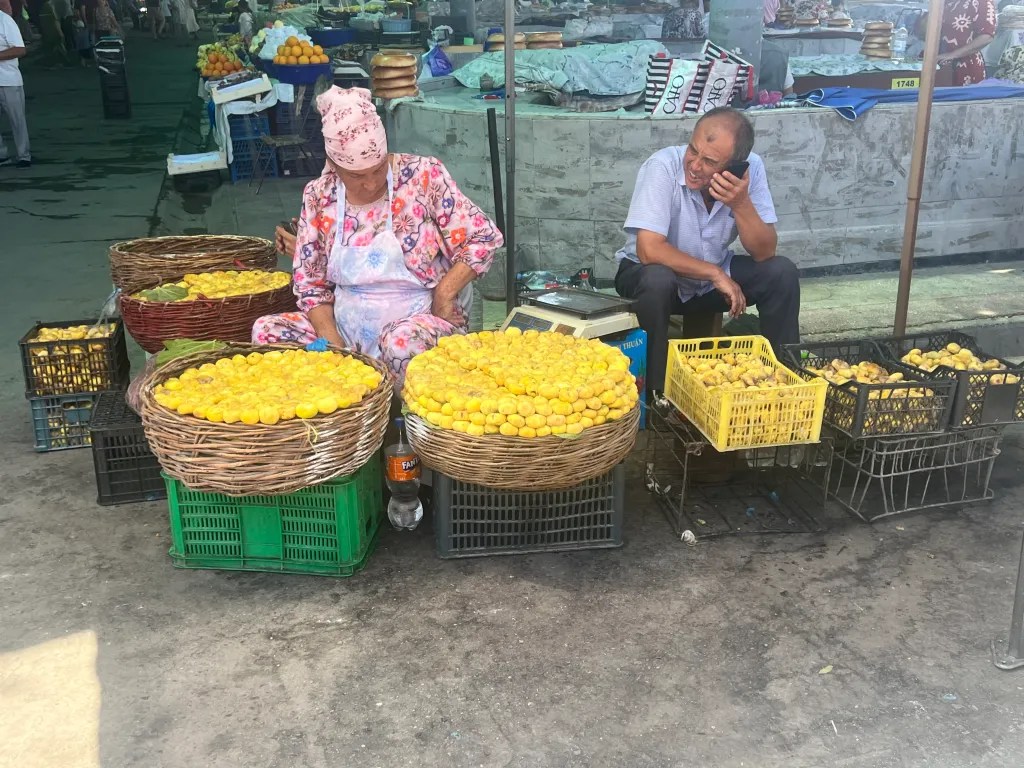


In Samarkand we highlighted places that were a must see and because of the layout of the historical sites you can easily walk from one to another with lots of places to stop off and enjoy a cold drink, a coffee and eat traditional foods, the perfect way to explore a city. We visited the famous Siab Bazaar, otherwise known as the Syiyob market, named after the river. It is also the largest and oldest marketplace in the city. The building is built in the shape of a dome and underneath there are many pavilions and shopping arcades. The main entrance has a triple arch lined with blue majolica. The area of the market is more than 7 hectares. It is famous for its size and the fact that it is located along the ancient Silk Road. It is a vibrant place with traditional crafts, aromatic spices and delicacies of the country. It is famous for the Samarkand flatbread baked on the traditional tandoors with over 17 different varieties. They are extremely popular and can stay soft and fresh for up to three weeks! Many of the stalls were piled up with delicious produce that had your mouth watering. We passed many locals drinking traditional green tea, chatting and catching up with life, a definite must visit when in Samarkand.


Close to the market is the Bibi Khanym Mosque which is one of the most important monuments of Samarkand and is now an historical building under UNESCO and is for the tourist, it is no longer an active mosque for prayer. This magnificent building was at during it’s time one of the largest mosques in the Islamic world. If you are visiting Samarkand we would highly recommend that at each site you visit you look at hiring a guide. Most historical sites have guides sitting around offering their services, and they are excellent value for money as they certainly bring the place and history to life for you. This mosque has survived a number of earthquakes as well as conflicts and has been cleverly restored. Timur, a Turco-Mongrol conqueror, wanted to construct a gigantic mosque in his capital back in 1939 and by 1404 it was nearly complete, but he wasn’t happy and made some changes, however his ideas and changes pushed the building to its limit and it did start to collapse. One of the minarets was in fact leaning so badly it had to be rebuilt and you can still see a little lean today!


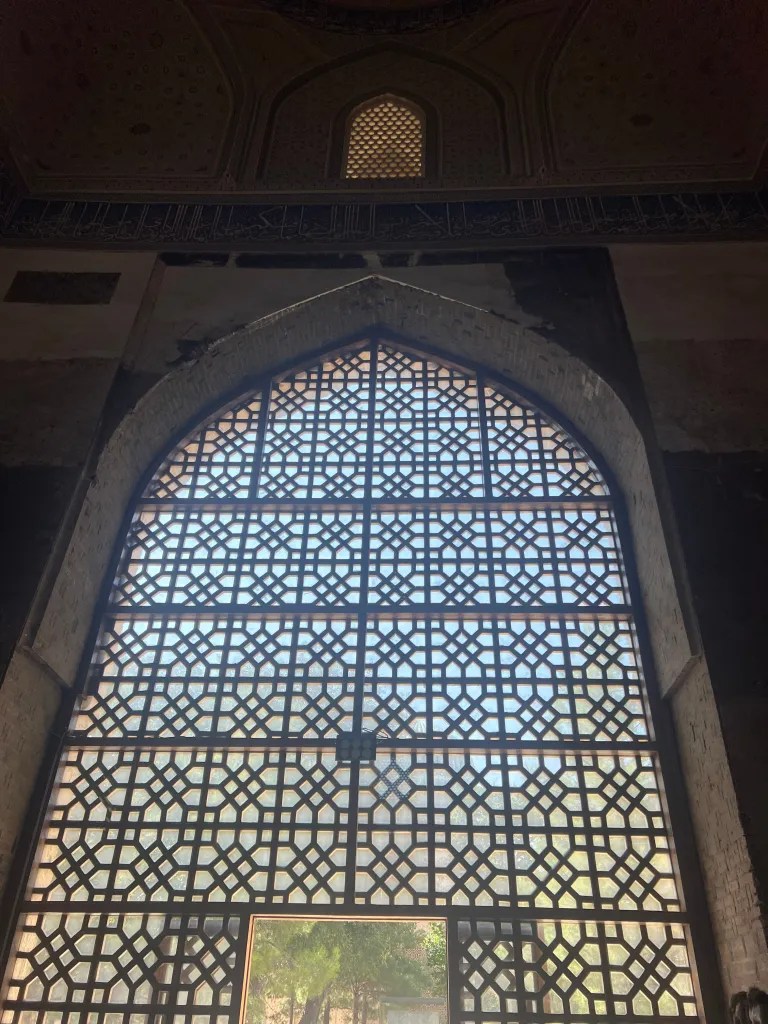


Another iconic historical site, in fact probably the most iconic, is the Registan Square. Here we had another great tour guide who shared so much history and detail about the three main buildings that stand proud in this square. The Registan translates into Sandy Place in Tajik and was the commercial centre in its day. This square is a UNESCO world heritage site and is in the heart of the city and a masterpiece of Islamic architecture. There are three madrasas which are still standing and intricately decorated. We had the opportunity to explore inside and saw where the dormitories would have been, where the young schoolers would have been taught and where they would have slept. One of them houses the golden mosque which was truly stunning. We ambled and soaked up the fabulous history of this symbolic square. We also visited the Registan at night because every evening there is a spectacular light and laser show with vibrant 3D projections and displays that light up the buildings. This show is choreographed to traditional Uzbek music and highlights the region’s rich Silk Road history.


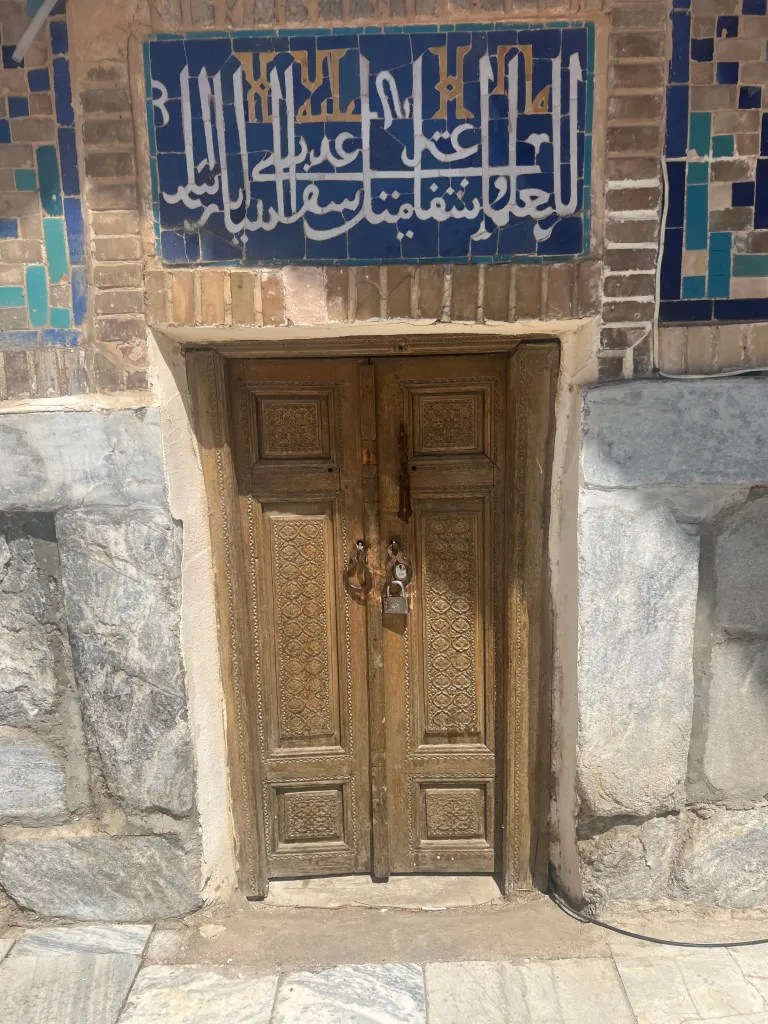


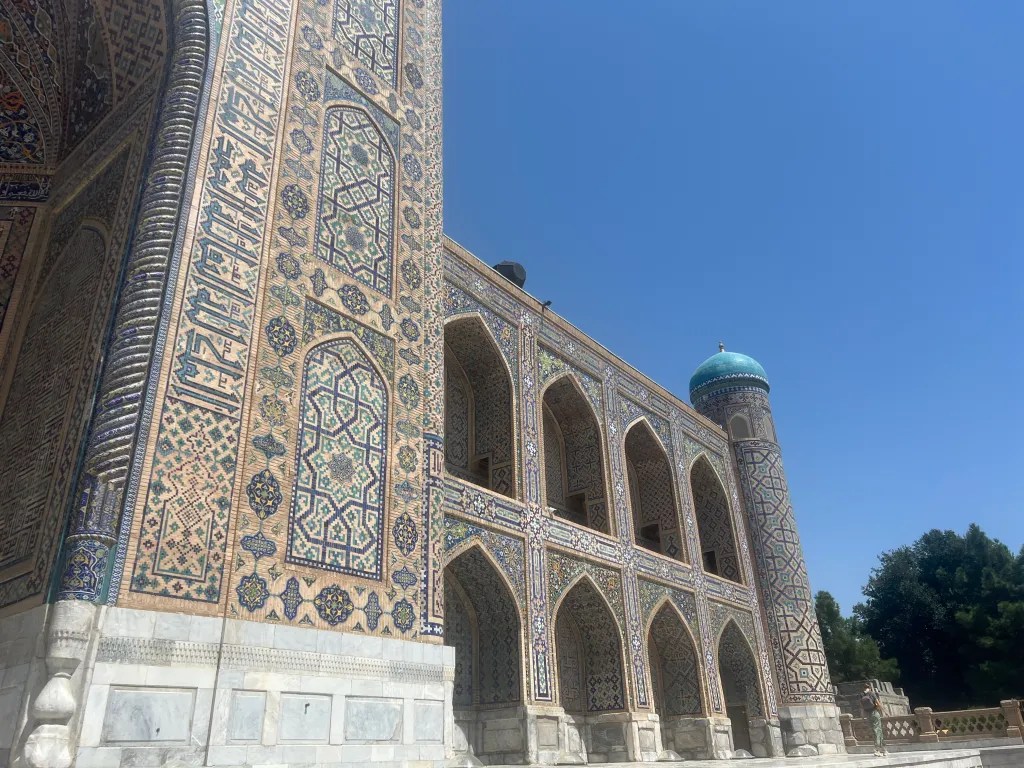


Several world changing scholars in Mathematics and Science originated from Uzbekistan and laid the foundations for algebra, modern algorithms, astronomy, and medicine and we had read that The Ulugh Beg Observatory that was built in the 1420’s by the astronomer Ulugh Beg was one of the best in the Islamic world and so we paid it a visit. We wandered around the museum and stood in awe of the importance of this observatory that produced the most accurate star catalog and calculated the sidereal year to last exactly 365 days, 6hours, 10minutes, and 8 seconds—missing the modern electronic calculation by less than a minute!


Next on our visit to Samarkand was the Shah-i-Zina, which is said to be Samarkand’s most moving and beloved site with its avenues of mausoleums which have some of the richest tile work in the Muslim world. The meaning of Shah-i-Zina is “The Living King” which is meant to have derived from the ancient myth where Qutham Ibn Abbas, a cousin of Prophet Muhammad came to Samarkand in the 7th century to preach Islam; according to the myth he was beheaded for his faith but he picked up his head and descended into a deep well where he remains alive and in hiding to this day. It is a UNESCO listed cemetery and is one of the most significant Islamic pilgrimage sites in Central Asia. It is famous for its breathtaking street of more than twenty structures and mausoleums that date back to the 14th and 15th century, with the intricate blue, teal and gold tile work which were absolutely stunning. A place of peace and tranquility.


The first thing we did in Bukhara was to enjoy a traditional Uzbek dish of Plov! It is actually a popular Central Asian and Eastern European dish. It is a hearty, fragrant one-pot meal made by layering and steaming long-grain rice over a rich base of tender meat, typically lamb or beef, with carrots and onions. Plov is seen as unique because it combines three cooking techniques, frying, boiling and steaming. Chunks of meat are seared in hot oil and then generous amounts of onions and carrots are added. Whole heads of garlic, spices including cumin, coriander and paprika are then added to the ingredients with water where it is left to simmer; then the rice is layered over the meat and vegetables and the entire dish is covered and steamed until the grains of rice are fluffy and have absorbed the flavours. It was delicious and we would highly recommend you try it if travelling in Central Asia.

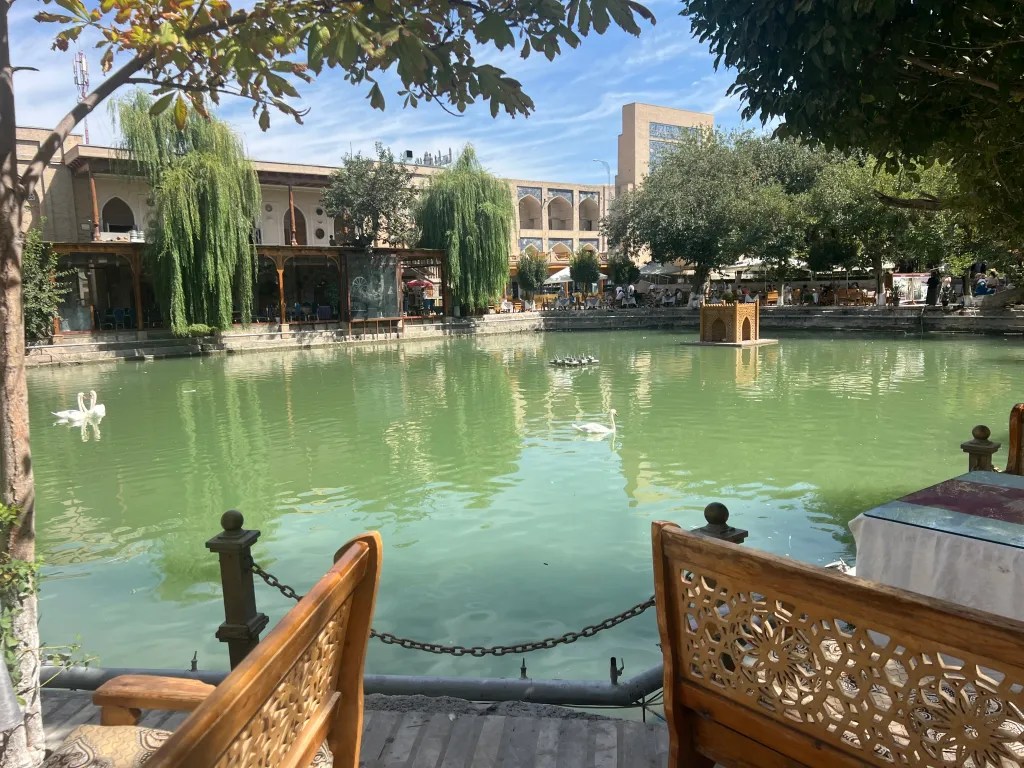
There are many historical and famous places to visit in Bukhara and to get a feel of the ancient city we hired a golf cart. We would suggest you do this to give you an overall feel of the city as well as find out where all the places of interest are that you can return to at a later date. We hired one that took four of us for an hour around the sites with a few stop offs for us to explore. The first stop was the Lyabi Khause square. This is a historic public plaza and is in the heart of the city of Bukhara. Its name translates from the Persian “by the pool” which is making reference to the central reservoir that sits in the centre. Today this is surrounded by places to eat and we enjoyed a few nights watching the place light up eating delicious food. This pool is one of the very few surviving pools as most were filled in during the Soviet era. On three sides of the square there are magnificent Islamic buildings with one of them being constructed originally for the Silk Road merchants to stay at before it became a school.




We visited the Chor Minor monument, an historic gatehouse with four turquoise domes. It is a distinct gatehouse in Bukara and is the only surviving entrance to what was once a grand madrasa. The four towers aren’t actually minarets as they were never used to call the faithful to prayer, in fact they are purely decorative. They look identical from afar however they are different with their own unique shape and decorations.


We visited the Abdulaziz Khan Madrassah, which is a 17th century Islamic theological school in Bukhara and is known for its lavish, intricate and some believe its non-traditional Central Asian architecture. Construction was suddenly halted and left partially unfinished when Abdulaziz was dethroned. It was designated as a UNESCO World Heritage Site in 1993.


We visited a museum called Zindran which is the infamous historic prison in Bakhara built in the late 18th century. The most famous and perhaps most chilling feature is the kanakhona which is 6.5 metre deep and 5 metre wide underground pit where prisoners were lowered by ropes alongside insects and reptiles. It historically held debtors, religious violators and notably two British officers, Charles Stoddart and Arthur Conolly who were executed here during the 19th Century “Great Game”. The term “Great Game” was actually coined by Conolly to describe the 19th-century rivalry between the British and Russian Empires; it was used as a chessboard metaphor. Both Stoddart and Conolly were executed in 1842 on charges of espionage after being accused of being spies for the British Empire; however they were arrested and imprisoned for different reasons. Stoddart was imprisoned in 1838 as he offended the Emir by arriving without a personal letter from the British Queen and rode his horse into restricted royal areas and failed to bow properly. Conolly arrived in 1841 and he attempted to form a coalition of the Central Asian Khanates against a Russian expansion. His letters were intercepted and the Emir accused him of conspiring against him


The Po-i-Kaylan mosque complex was another historical stop. This is a prominent Islamic religious ensemble and can be found in the centre of Bukhara. It dates back to the 12th century. The complex consists of three main monumental structures. The most iconic has to be the Kalyan Minaret, (Tower of Death) which was built in 1127 and is a tower measuring 47 metres. It was originally built to summon the faithful to prayer as well as serving as a watchtower and guiding light for the Silk Road travellers as they crossed the desert. This is the oldest structure and seen as an engineering marvel as it has survived the destructive conquests of Genghis Khan. The reason it was given the name of Tower of Death is because it was used as an execution tower in the early 20th century where criminals were thrown from the top rotunda. In this complex is also the Kalyan Mosque which is one of the largest mosques in Central Asia. It has a large open courtyard with 288 domes and 208 ornate pillars with many beautiful blue tiled mosaics. The final building is the Mir-i Arab Madrasah which is an active Islamic school which again is known for its attention to detail with turquoise domes and intricate tile work. This building is also a UNESCO World Heritage site and an important destination for those who are exploring the Silk Road. It’s a must see at night!


The historical site we left till last was the Arc, a fortress in Bukhara. We had an excellent guide who gave us a detailed talk and tour of the Arc. This was a fortress for many years where the royalty resided. It covers about 4 hectares and is about 20 metres high above the Registan below. It is said to have been built at least 15 centuries ago. For centuries it was the residence of the Emir of Bukhara. Great rulers and scholars would have also resided in the fort. There is a legend tied to this fortress related to a Persian hero called Siyavush. According to the legend this hero managed to outwit the King. Whilst fleeing into exile, Prince Siyavush arrived in Turan and fell in love with Princess Farangis, the daughter of King Afrasiab. The King was not impressed with the idea of the prince marrying his daughter and set an impossible challenge, so he thought! He told Siyavush that he could only marry the Princess if he built a palace that would fit on a single bull’s hide. But Siyavush was clever, or some would say cunning, he took the bull’s hide and cut it into extremely thin strips, tied them together and formed a large enough circle to build a palace! Thus according to legend the Arc was born.


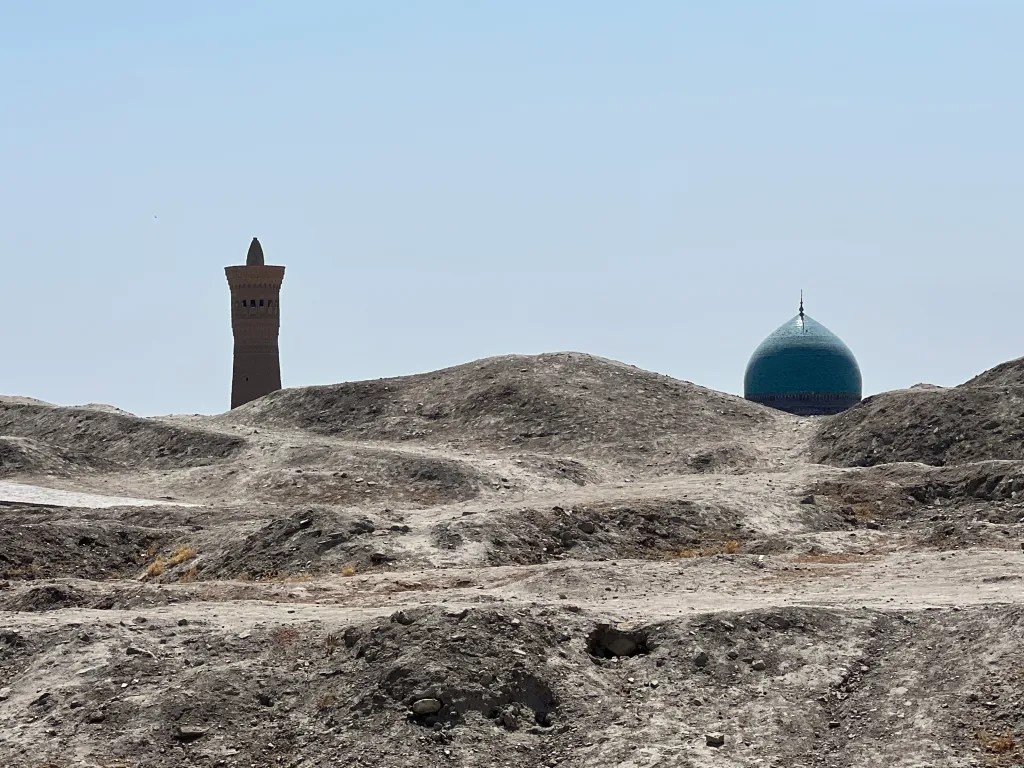


Samarkand and Bukhara were the perfect cities for the finale of our Silk Road journey. We had loved our adventure, from way back when we had arrived in Kyrgyzstan to leaving Uzbekistan. We felt privileged to have made this awesome journey that many traders and explorers had completed thousands of years ago. We had completed 76 days of travelling through Central Asia making memories to treasure.


